I want to write about the Chamba Rumal, but not in the usual way. I won't start with the typical lines about "17th century heritage craft, GI tagged, double sided embroidery" that every blog uses. I'll cover that, I promise. My story is different because I traveled all the way to Chamba for the Rumal, but never actually saw one there. Instead, it found me months later, near my home, on the back of a brownie box.
Let me start from the beginning.
Chamba jaana zaroor
It was April 2023. We had spent most of 2022 traveling through Himachal, exploring places like Shangarh and the remote areas of Kinnaur. This was before Instagram made "hidden places" popular, when the roads were rough and finding a spot really meant discovering it for yourself.
So in April 2023, we thought, chalo Chamba. I'd never been. And honestly, a big part of me just wanted to understand why Mohit Chauhan sings that line:
"Maaye ni meriye, Shimle di raahein, Chamba kitni door…
Shimle ni basna, Kasauli ni basna, Chambe jaana zaroor."
(It's an old Himachali folk song. Mohit Chauhan just made it famous.)
We only had 3 days, so the plan was simple: Dalhousie and at least the vibe of Chamba town. No proper itinerary, nothing booked. We stayed in Bilaspur a day before and then waha se nikal gaye. We wanted to see Dalhousie and feel Chamba, that's it.
And somehow we reached Dalhousie. I say "somehow" because my god, it is faaar. Dooooooor. I knew it was far on paper, but I did not expect it to be this far. We were genuinely taken aback and completely wiped out by the time we rolled into Dalhousie.
The cafe that actually delivered: Café by Mongas
About 20 minutes before Dalhousie, we stopped to eat at Café by Mongas. It just pulled me in, such a sweet, cute little place that I was like, "we HAVE to go in."
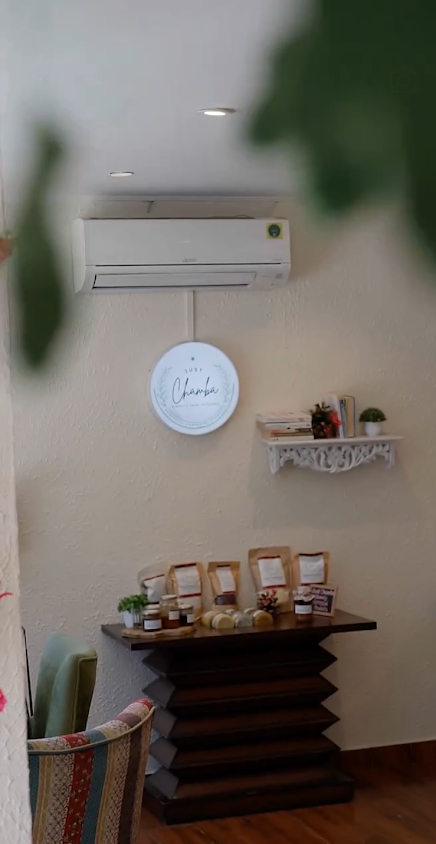
The vibe inside. Plants, warm light, and that little "Just Chamba" board on the wall.
And it surprised me, because most cafes like this only look good and serve you nothing. This one delivered. The blueberry tea was genuinely good, and the pasta was delicious.
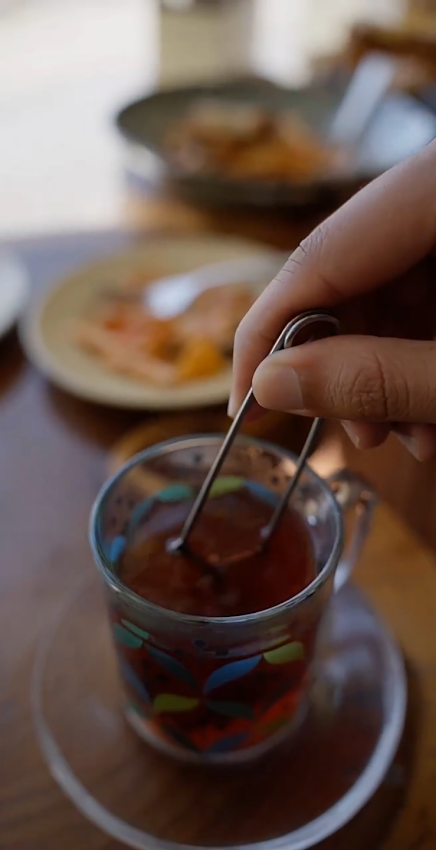
That blueberry tea. Small thing, but it made the tired evening better.
The best part was that they'd stocked local produce on a rack for you to actually buy. Real stuff, under a label called "Just Chamba, Naturally Harvested Products." Chambyali ghee, Chambyali rajma, local flours.
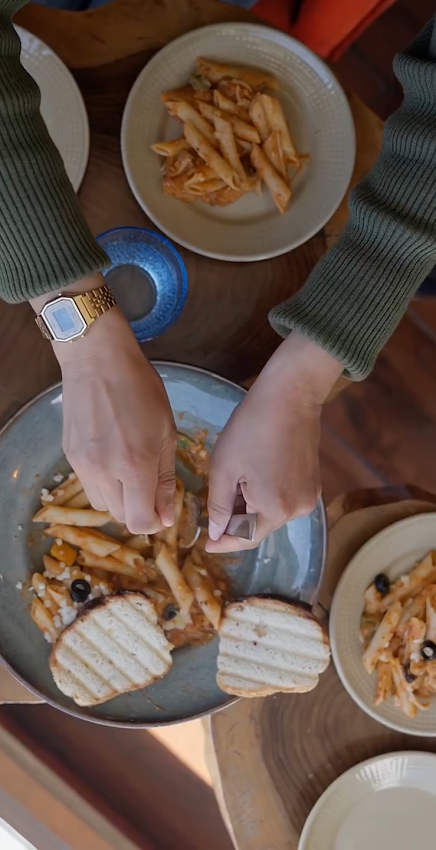
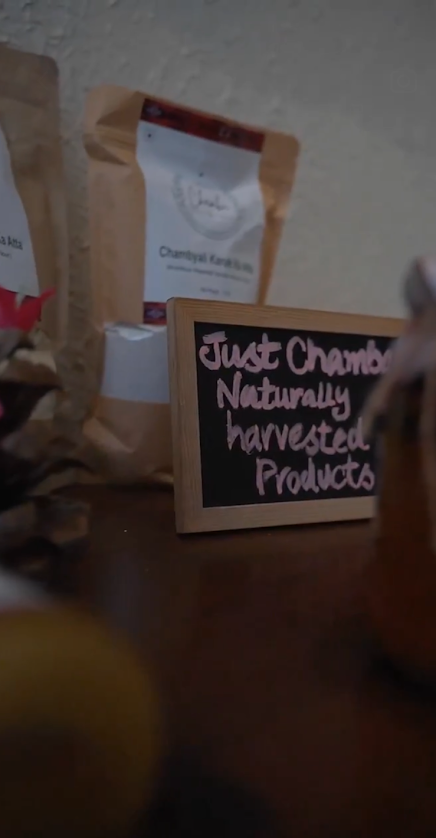
The best part was that they'd stocked local produce on a rack for you to actually buy. Real stuff, under a label called "Just Chamba, Naturally Harvested Products." Chambyali ghee, Chambyali rajma, local flours.
I really liked it here. Some places show respect for their location, and this one did just that.
Khajjiar: beautiful, until one guy decided to ruin it
The next morning, after resting, we went to Khajjiar.
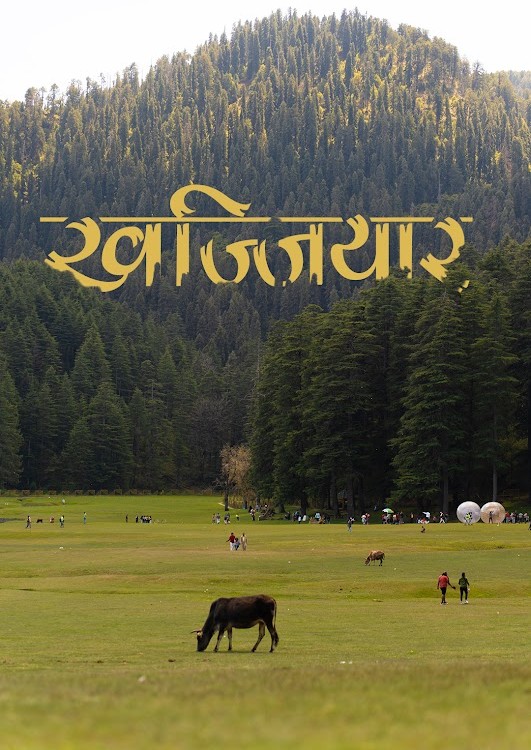
The beauty was breathtaking. The horses were gorgeous. I was just about to slip into that quiet, happy zone, standing right in the middle of the Khajjiar ground, when I heard it.
Music. Loud. Someone blasting it.
I was instantly pissed. Who does that here? I walked over to see, and sure enough, a guy had parked at the outer edge where all the cars go, opened the boot of his car where the speakers were, and he and his group were just standing there, letting it rip. Full volume, into the whole ground.
You could see it on people's faces. The ones sitting toward the far end kept turning to look, clearly annoyed, and eventually just… moved away. We took a few photos and left too.
And the worst part? Nobody said anything. Nobody told him to stop. He kept it going for way too long.
I lost my patience mostly because of the timing. This was just after Covid, when people had only just started traveling again. Usually, there were only a few people, everyone quietly enjoying themselves, and no one causing trouble. But then this one person decided, aaj toh shaanti bhang karni hai.
Chamba town: closed. On a Sunday. Of course.
Then we headed toward Chamba itself. It was a Sunday, and I was genuinely excited; this was the day I'd finally see the Chamba Rumal and visit the famous museum in town.
(That museum is the Bhuri Singh Museum, literally the one place that holds the oldest, most exquisite original Rumals.)
But before we even got close, we hit traffic. Hell lot of it. It was a small single lane road, not a 2 lane or 4 lane highway, and people had just parked their cars along it and wandered off into the jungle to roam. So everything jammed. It ate up half our day just to clear.
By the time we reached Chamba city, being Sunday, everything was shut. Every shop. The museum too.
I was like, shit.
So the Rumal I'd driven all this way for stayed exactly where it had always been: just out of reach. We roamed the town a little, but we had to head home the next morning, so we drove back to Dalhousie for the night.
But here's what I keep thinking about. The Chamba Rumal is not just a "handkerchief." It's called needle painting for a reason. Women, including the royal ladies of Chamba, used to embroider entire scenes onto fine muslin or khaddar with untwisted silk floss. They used a double sided technique (do-rukha, or dohara tanka) so precise that the picture looked the same on both sides of the cloth. Scenes like Krishna's raas-leela, the Ramayana, and Radha and Krishna were often inspired by Pahari miniature paintings. Traditionally, the Rumal was part of weddings; a mother would tuck coins and fruit into it and give it to her daughter as she left home. It was a cloth given with love, wrapping small treasures inside.
Keep that last bit in your head. It matters for how this story ends.
Kalatop: the part that saved the trip
The next morning we woke up early and went to Kalatop. My god. This was the best part of the whole trip.
It's a wildlife and forest department area, and the moment we got there, the whole mood shifted. There's this cute little forest guest house, some adventure activities, and a calm you just don't get at the crowded spots.
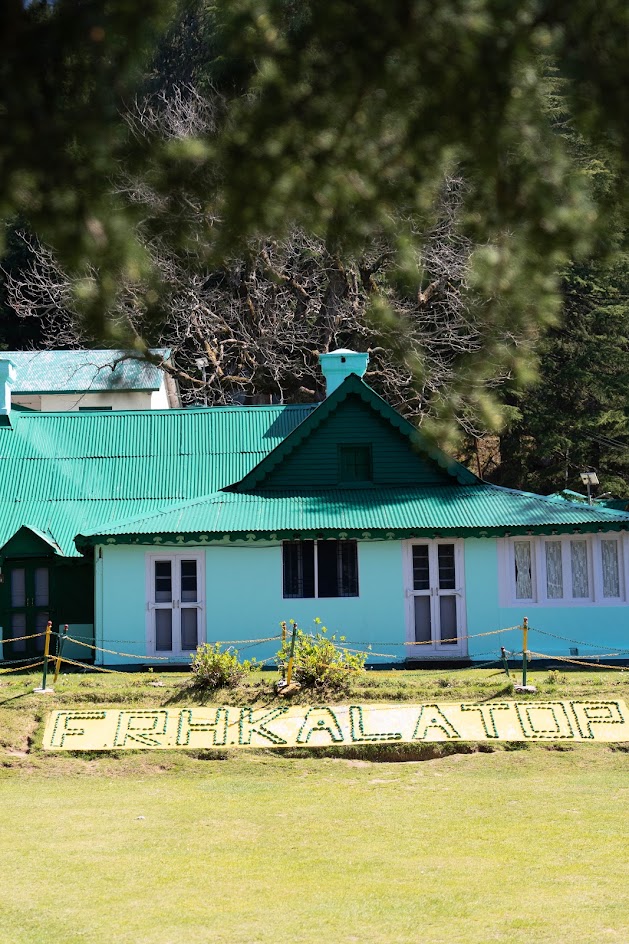
Forest Rest House, Kalatop. Established 1925, sitting at around 8,000 ft.
I loved everything about the place, from the atmosphere to the food. There is also a nearly 200 year old deodar tree standing there.
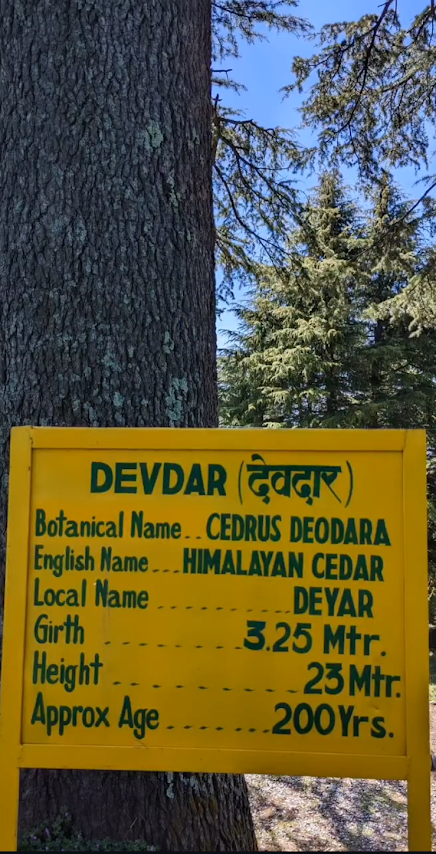
Cedrus deodara. Girth 3.25 m, height 23 m, roughly 200 years old. Standing there long before any of us showed up, and long after.
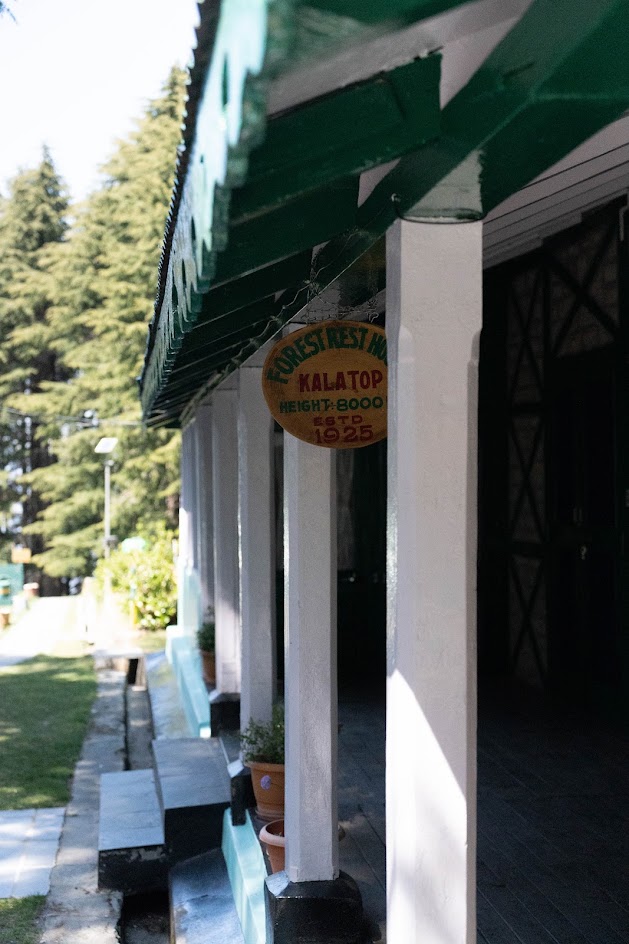
The kind of old wooden home you still find perched on these ridges.
It was a truly beautiful spot. Then we left for home, and I have to say again, Chamba is really far.
Woh na sahi, toh ye hi sahi
So I came back without a Chamba Rumal. Didn't buy one, didn't even see one. The whole reason I went, and I missed it.
But here's the twist.
A few months later, I found a bakery near home and wanted a brownie. While I was standing there reading the ingredients on the box, like I always do, I turned it over.
And there it was. Chamba Rumal. Printed right on the back, with a little write-up about the craft.
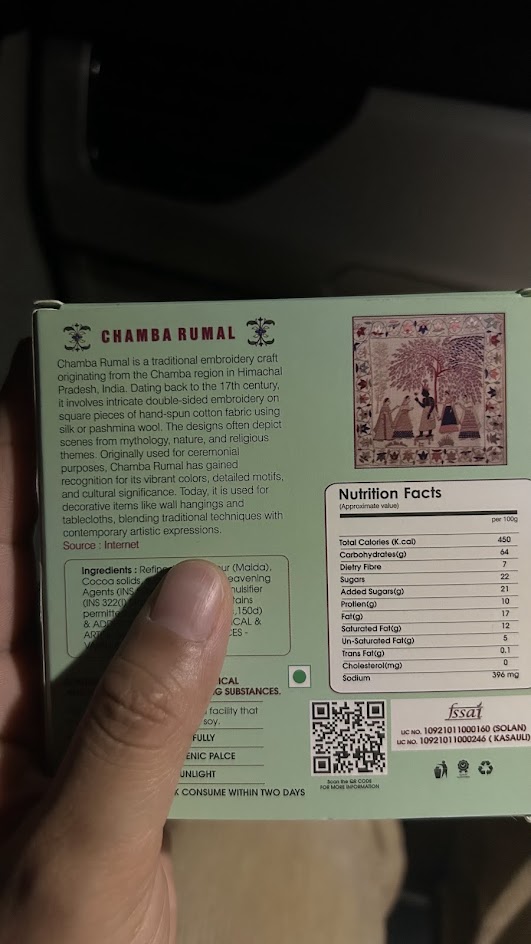
The Rumal I drove hundreds of kilometres for… found me on the back of a dessert box, 20 minutes from home.
I bought it, obviously. Woh na sahi, toh ye hi sahi. Hehehehe.
And you know what, think about it. The Chamba Rumal was always the thing you wrapped a gift in. Coins, fruit, a blessing for a daughter. It was never really about the cloth; it was about what it carried and who it was given to.
So maybe it's fitting that mine didn't come from a museum glass case. It came wrapped around something sweet, handed to me when I wasn't even looking. Chamba kept its distance, but the Rumal still found a way home.
Next time, properly
I know Chamba has a lot more to offer. Next time, I'll go for at least 7 to 10 days with a proper plan, instead of just wandering around. I want to see the Bhuri Singh Museum, the real Rumals, the old town, and everything else.